Planning guide · October 2026
Why 2027 is a different planning year
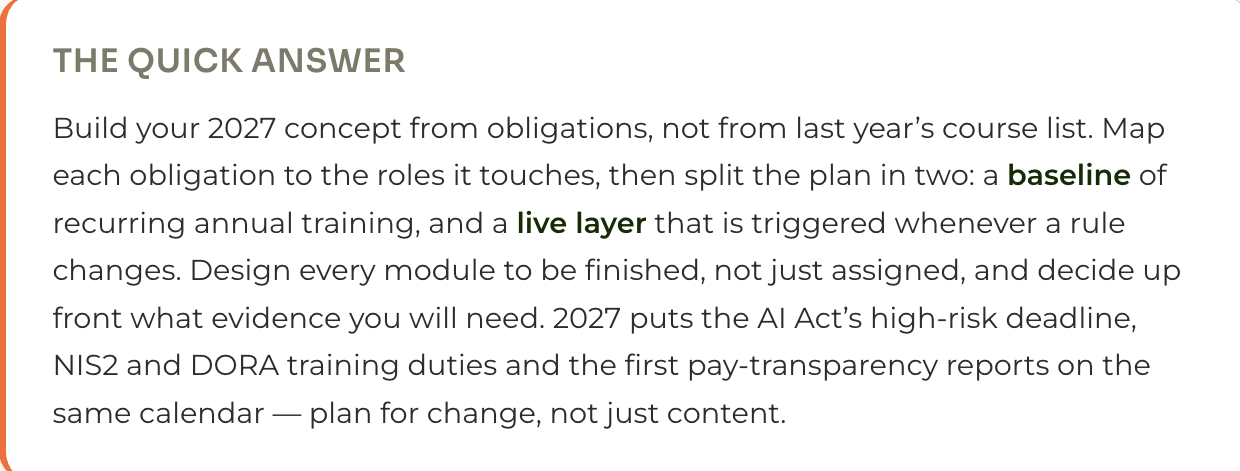
The traditional training plan assumes the rules stand still for twelve months. Several European regimes that touch ordinary staff — not just specialists — reach operational maturity at the same time, and at least one of them changed shape mid-flight.
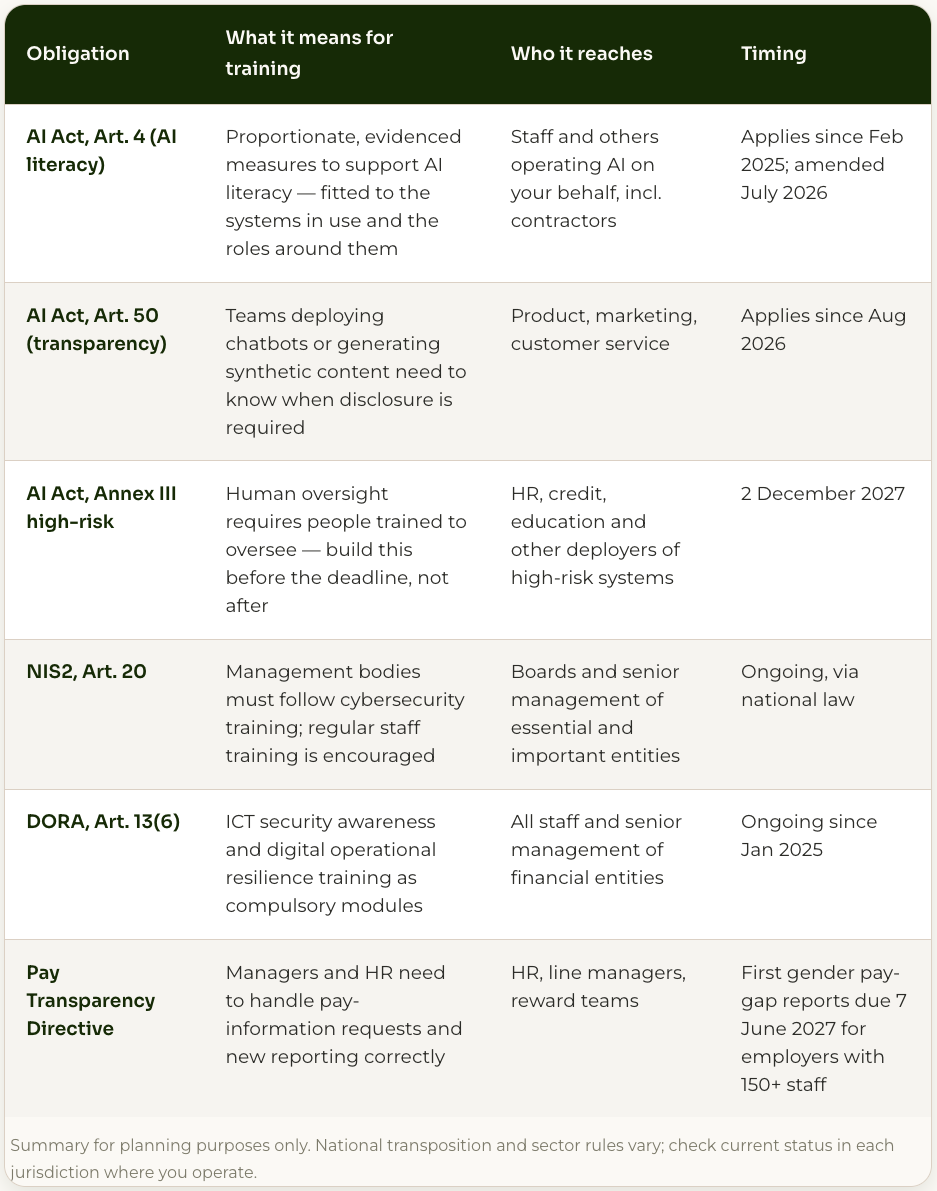
The clearest example is the EU AI Act. The Digital Omnibus on AI, Regulation (EU) 2026/1744, entered into force on 27 July 2026. It moved the high-risk obligations for stand-alone Annex III systems — recruitment, credit scoring, education and others — from August 2026 to 2 December 2027. It also rewrote Article 4 on AI literacy: the duty moved from ensuring a sufficient level of literacy to taking measures to support its development. That reads like a relaxation. In practice it is a documentation duty: you no longer have to guarantee what each person knows, but you do have to show what you did.
Plans written against the original AI Act timeline are now describing a text that no longer exists. That is the 2027 problem in miniature: a training concept is only as good as its last regulatory update.
1. Start with an obligations register, not a course catalogue
Start with last year’s course list, and you risk planning last year’s training. Instead, list the obligations that apply to you in 2027 — regulation, sector rules, internal policy — and note for each one whether it requires training explicitly, implicitly (as with human oversight) or not at all. Courses come later; they are the output, not the input.
2. Map every obligation to the roles it touches
3. Split the plan into a baseline and a live layer
4. Design for completion, not coverage
5. Decide what evidence you will need — before you build
6. Budget for change, not just content
7. Review quarterly, against the register
Where Lexstream fits