Updated September 2026
Learners reward provenance, not humanity
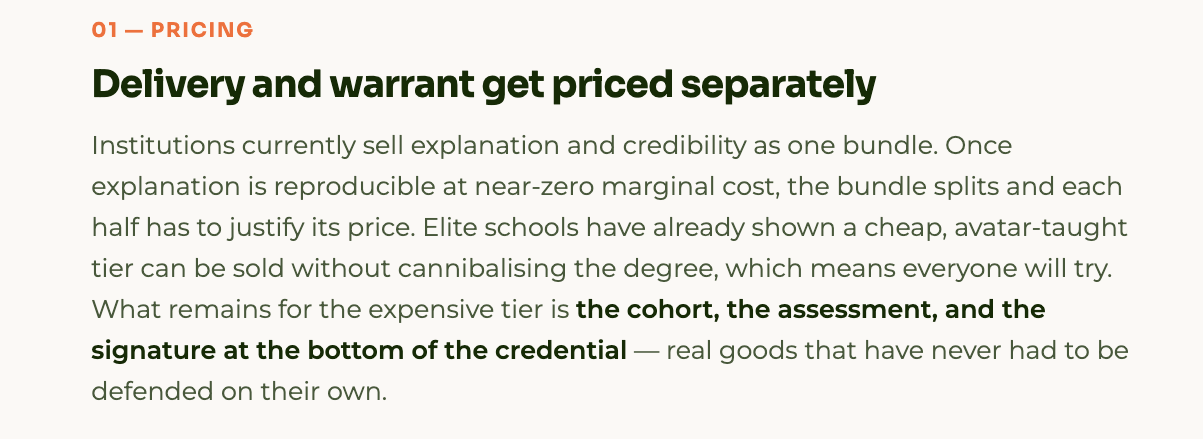
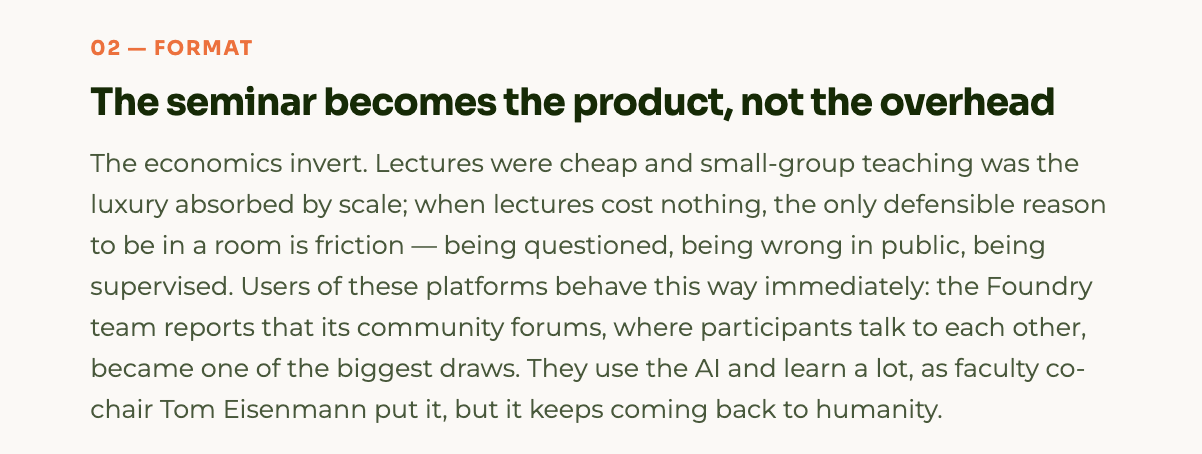
The clearest signal so far comes from a single effort, and it is worth taking seriously because the team was not looking for it. Harvard Business School’s Foundry programme — the $699 course at the centre of the Times report, in which participants pitch to AI clones of seven faculty who volunteered to be cloned — began in 2024 as a ChatGPT-style chatbot for founders, and was redesigned after trial feedback.
The surprise came next: the team cloned specific, named professors, and the response was overwhelmingly positive. Project director Katharina Rings’ summary is that people seem to much prefer the AIs, and to trust them more, when they are based on one specific person’s input.
The same instinct shows up in reverse in a classroom experiment at George Mason University, where students described the AI instructors as monotone and robotic, said they would prefer a human, and then — asked whether the videos should be removed — kept them. That is not inconsistency. It is a trade: they will accept less warmth in exchange for two things they value more — a source they can name, and availability at an hour they are actually free.
Which cuts against the direction most of the industry is pushing. Enormous effort is going into making avatars more convincingly human. Learners are not paying for humanity but for provenance — the assurance that an explanation derives from someone qualified, identifiable and accountable. That rearranges the whole debate, because provenance survives copying and presence does not.
What was actually scarce
Knowledge has not been scarce since the library, and certainly not since the search engine. Lecture delivery has not been scarce since the MOOC. The constraint that never moved is the one an educator involved in these programmes stated plainly: he can hold twenty or thirty meetings a week, and beyond that he cannot — he cannot service his class in person constantly, let alone his campus, so he needs a way to scale.
That is the real bottleneck in education, and it has a name: attributable attention. Time from a specific person whose judgement a learner has reason to trust, pointed at that learner’s particular problem. Every structure in academia — office hours, supervision, seminars, tuition fees — is a rationing mechanism for it.
Avatars do something genuinely novel to that good. They do not replace the attention; they reproduce a thin, patient, always-available version of it while keeping the attribution intact. This is why the technology is more disruptive than earlier online learning: MOOCs scaled content and stripped attribution, while avatars scale a facsimile of contact and keep it.
The pipeline, not the avatar
If provenance and availability are what matter, the technology lands first wherever those dominate charisma. That has meant regulated knowledge — law, safety, tax, medicine — and it is worth looking at how the organisations serving those fields are actually built, because the architecture is the argument.
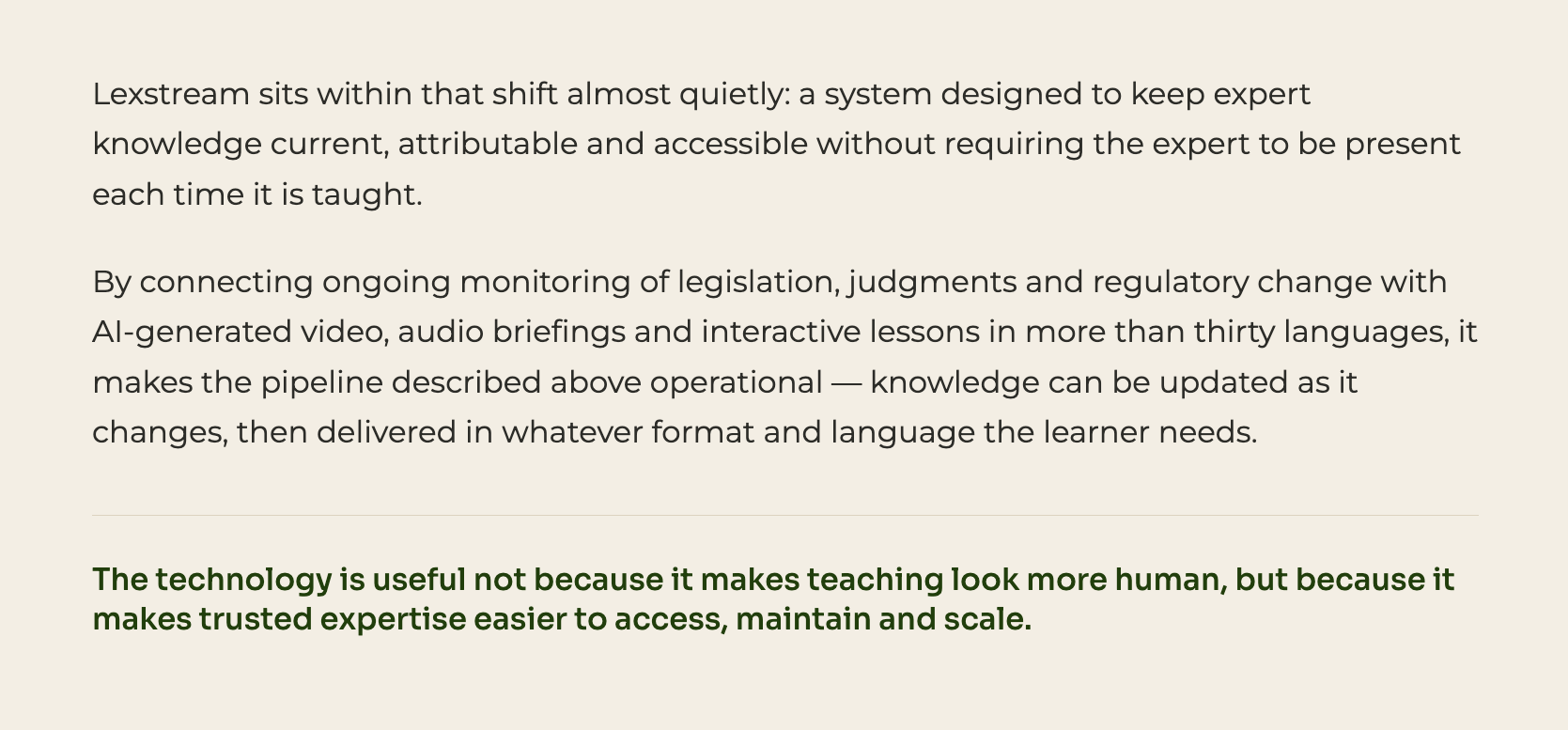
Lexstream is a useful specimen of the type. It runs two coupled layers. One monitors where codified knowledge changes: legislation, judgments, regulatory updates and news, consolidated into a single feed. The other converts dense source documents — the sort nobody reads — into video, AI-generated audio briefings and interactive lessons, delivered by realistic avatars in over thirty languages. Its users are companies, universities, law firms and NGOs.
The avatars are the visible part and the least interesting. What matters is the coupling. The system is built on an assumption academia has never had to design around: the material will change, and the same population will have to be re-taught. Monitoring without teaching produces alerts nobody acts on; teaching without monitoring produces courses that quietly go out of date. Joining them makes the unit of work a pipeline rather than a course.
Universities have both layers already, and in a far more prestigious form — research produces knowledge, teaching delivers it. But the seam between them is slow and manual: a finding travels to a syllabus through publication, textbook revision, curriculum committee and a re-recorded lecture, on a cycle measured in years. Nobody designed that lag. It was the price of the production economics, and the whole sector knew it and lived with it.
Compliance-driven education could not live with that lag, because a regulator asks when the rule changed and whether the affected people were taught. So it built the pipeline first — not out of foresight, but because the alternative was liability. Higher education is now converging on the same shape from the opposite direction: discovering, via avatars and synthetic video, that continuous revision is affordable, and only then asking what it would be for.
The boundary of the model is worth stating plainly, because it is where the university’s advantage actually sits. This architecture suits codified knowledge — material with a current correct answer that somebody is accountable for. It does very little for contested, interpretive or emergent knowledge, which is a large part of what a university exists to handle. A disagreement cannot be pipelined. A well-run seminar on an unsettled question is not an inefficient lecture waiting to be automated; it is a different activity, and one whose relative value rises as everything around it gets cheaper. The honest reading of the vocational model is not that it will absorb academia, but that it reveals exactly which half of academia was industrialisable all along.
The supply side broke quietly
Meanwhile the production economics stopped being arguable. IU International University of Applied Sciences in Germany, serving over 100,000 students across more than 1,300 courses, ran a media team of 200-plus people editing studio-shot lectures — impressive, and structurally stuck: slow to update, expensive to keep consistent. With synthetic video it cut production from several months to about two weeks and put AI video into roughly 100 courses in under a year. What improved was not comprehension but throughput and mutability. A lecture became a document to be edited rather than a performance to be re-shot.
That makes a property previously unaffordable suddenly cheap — curriculum currency. When updating a course costs a studio day per lecturer, drift from reality is tolerated. When it costs an afternoon, drift becomes a choice, and eventually a liability. Compliance-driven education has always been judged on currency, because someone audits it; degree programmes never have been, because updating was prohibitively expensive and everyone knew it. That excuse is gone, and students, employers and eventually accreditors will start asking when a curriculum was last revised.
Nor is this confined to one institution. Researchers at Graz University of Technology, working in the Unite! European alliance, produced MOOCs with synchronised avatars in English, Spanish and Portuguese without lecturers re-filming — and were congratulated on their fluent Spanish. Beyond academia, Synthesia’s 2026 research reports 52% of surveyed learning and development teams already using AI to create video, with a further 39% piloting or planning it. The infrastructure for teaching at scale is being built largely by people who never had a lecture hall to protect.
The professor becomes an asset
Their proposals — consent and withdrawal rights, transparency about when a student is addressing a representation, defined attribution for AI-generated content, recognition of the effort in workload terms — amount to a charter for a profession that has just discovered its labour can be copied. The incentives run the wrong way: the more trusted the name, the more valuable it is to reproduce. Faculty contracts will become licensing agreements, and some of that will be lucrative while some of it will be ugly.
The pipeline, not the avatar
If provenance and availability are what matter, the technology lands first wherever those dominate charisma. That has meant regulated knowledge — law, safety, tax, medicine — and it is worth looking at how the organisations serving those fields are actually built, because the architecture is the argument.
Lexstream is a useful specimen of the type. It runs two coupled layers. One monitors where codified knowledge changes: legislation, judgments, regulatory updates and news, consolidated into a single feed. The other converts dense source documents — the sort nobody reads — into video, AI-generated audio briefings and interactive lessons, delivered by realistic avatars in over thirty languages. Its users are companies, universities, law firms and NGOs.
The avatars are the visible part and the least interesting. What matters is the coupling. The system is built on an assumption academia has never had to design around: the material will change, and the same population will have to be re-taught. Monitoring without teaching produces alerts nobody acts on; teaching without monitoring produces courses that quietly go out of date. Joining them makes the unit of work a pipeline rather than a course.
Universities have both layers already, and in a far more prestigious form — research produces knowledge, teaching delivers it. But the seam between them is slow and manual: a finding travels to a syllabus through publication, textbook revision, curriculum committee and a re-recorded lecture, on a cycle measured in years. Nobody designed that lag. It was the price of the production economics, and the whole sector knew it and lived with it.
Compliance-driven education could not live with that lag, because a regulator asks when the rule changed and whether the affected people were taught. So it built the pipeline first — not out of foresight, but because the alternative was liability. Higher education is now converging on the same shape from the opposite direction: discovering, via avatars and synthetic video, that continuous revision is affordable, and only then asking what it would be for.
The boundary of the model is worth stating plainly, because it is where the university’s advantage actually sits. This architecture suits codified knowledge — material with a current correct answer that somebody is accountable for. It does very little for contested, interpretive or emergent knowledge, which is a large part of what a university exists to handle. A disagreement cannot be pipelined. A well-run seminar on an unsettled question is not an inefficient lecture waiting to be automated; it is a different activity, and one whose relative value rises as everything around it gets cheaper. The honest reading of the vocational model is not that it will absorb academia, but that it reveals exactly which half of academia was industrialisable all along.
The supply side broke quietly
Meanwhile the production economics stopped being arguable. IU International University of Applied Sciences in Germany, serving over 100,000 students across more than 1,300 courses, ran a media team of 200-plus people editing studio-shot lectures — impressive, and structurally stuck: slow to update, expensive to keep consistent. With synthetic video it cut production from several months to about two weeks and put AI video into roughly 100 courses in under a year. What improved was not comprehension but throughput and mutability. A lecture became a document to be edited rather than a performance to be re-shot.
That makes a property previously unaffordable suddenly cheap — curriculum currency. When updating a course costs a studio day per lecturer, drift from reality is tolerated. When it costs an afternoon, drift becomes a choice, and eventually a liability. Compliance-driven education has always been judged on currency, because someone audits it; degree programmes never have been, because updating was prohibitively expensive and everyone knew it. That excuse is gone, and students, employers and eventually accreditors will start asking when a curriculum was last revised.
Nor is this confined to one institution. Researchers at Graz University of Technology, working in the Unite! European alliance, produced MOOCs with synchronised avatars in English, Spanish and Portuguese without lecturers re-filming — and were congratulated on their fluent Spanish. Beyond academia, Synthesia’s 2026 research reports 52% of surveyed learning and development teams already using AI to create video, with a further 39% piloting or planning it. The infrastructure for teaching at scale is being built largely by people who never had a lecture hall to protect.
The professor becomes an asset
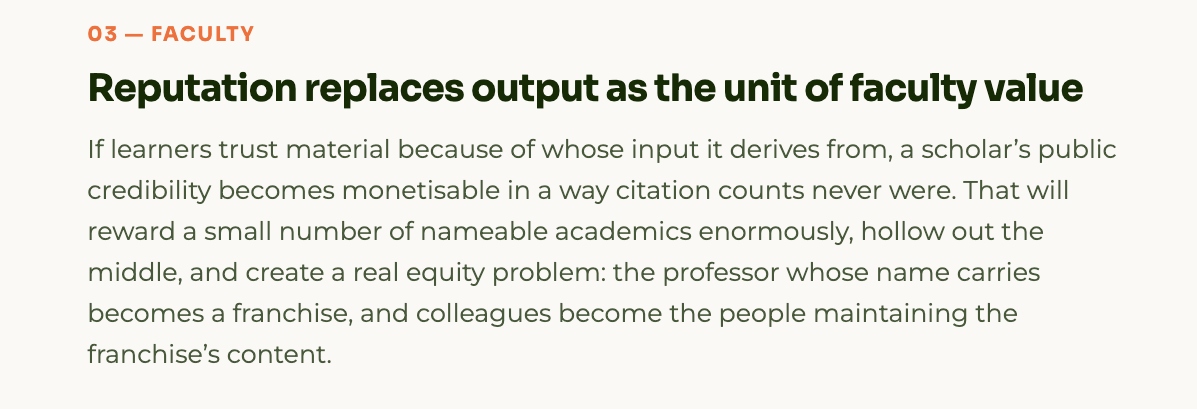
If a named expert’s provenance is the active ingredient, their name and likeness stop being incidental to their labour. Martin Ebner and Sandra Schön, writing for the European University Association after building avatar courses themselves, mapped the consequences before most institutions noticed there were any. Universities fund and generate the avatars, often with commercial tools — does that confer institutional ownership? Could a digital self appear in other courses without the lecturer’s involvement? Should an avatar keep teaching after someone leaves, retires, or dies? If it speaks in a lecturer’s voice and gets something wrong, or contradicts what they teach, who is accountable? Does building it count as teaching workload at all?
Their proposals — consent and withdrawal rights, transparency about when a student is addressing a representation, defined attribution for AI-generated content, recognition of the effort in workload terms — amount to a charter for a profession that has just discovered its labour can be copied. The incentives run the wrong way: the more trusted the name, the more valuable it is to reproduce. Faculty contracts will become licensing agreements, and some of that will be lucrative while some of it will be ugly.